
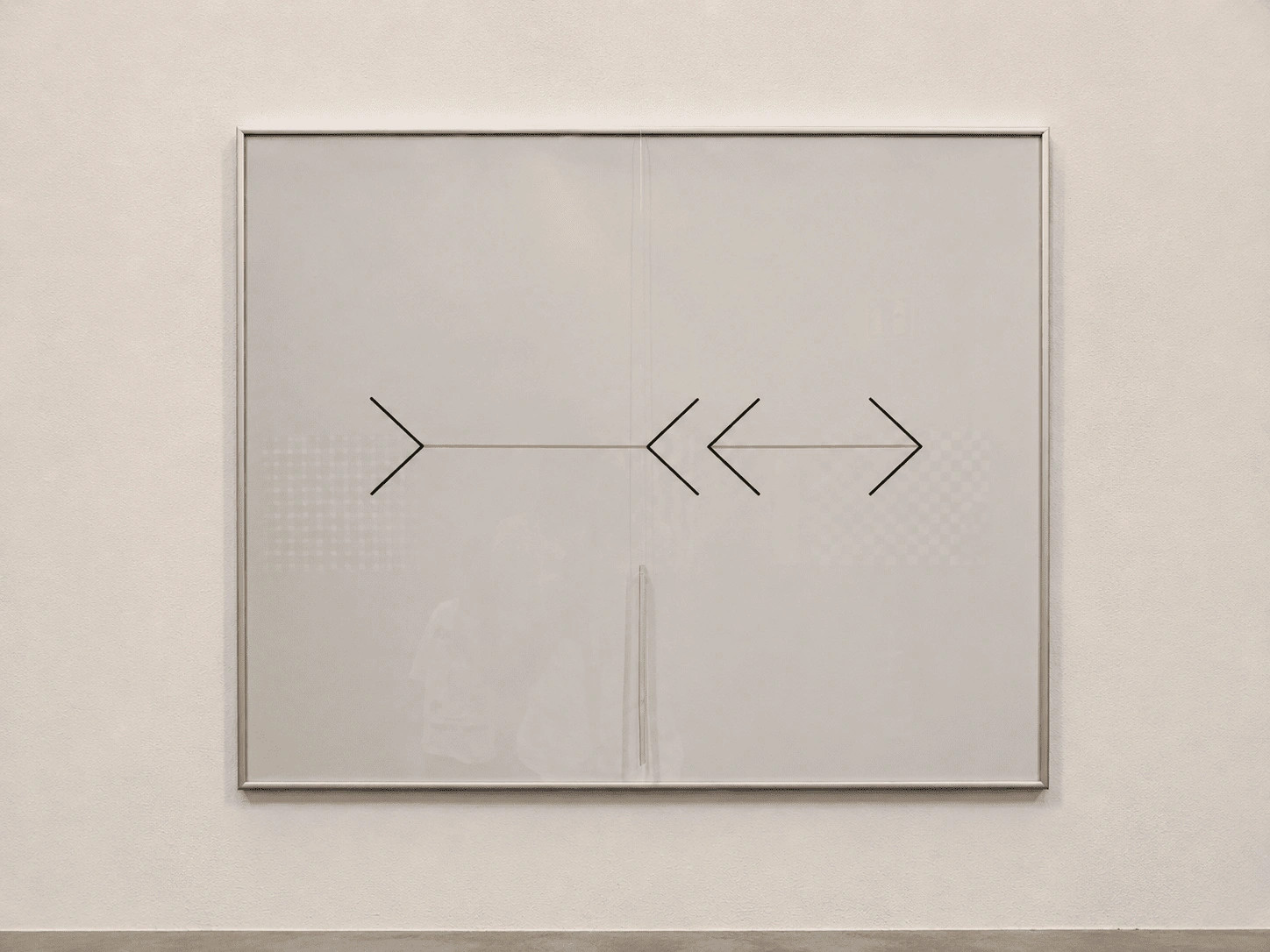
What if someone told you that two lines of exactly the same length could appear to be different? You would probably assume it was some kind of trick. Yet all it takes is adding a few small arrows to their ends for our brain to start interpreting a completely different reality.
The Müller-Lyer illusion is one of the most famous optical illusions in history. For more than a century, it has fascinated scientists, psychologists, and anyone who encounters it for the first time. What makes it so remarkable is not the drawing itself, but what it reveals about the human mind: what we see does not always match what is actually there.
What is the Müller-Lyer illusion?
The Müller-Lyer illusion consists of two lines that are exactly the same length. The only difference lies in the arrowheads placed at their ends.
One line ends with arrows pointing inward, while the other has arrows pointing outward. Although both lines are identical in length, most people perceive one as being significantly longer than the other.
Even more surprising, the illusion remains effective after you learn the trick and measure the lines with a ruler. Your brain knows the correct answer, but your eyes continue sending conflicting information.
This illusion is one of the best demonstrations that perception does not work like a camera. Instead, the brain constantly interprets the information it receives, and sometimes those interpretations lead us astray.
The story of Franz Carl Müller-Lyer
The illusion takes its name from Franz Carl Müller-Lyer, a German sociologist and psychologist born in 1857.
In 1889, he first published this visual phenomenon while studying how humans perceive shapes and space. At the time, psychology was emerging as a scientific discipline, and optical illusions became invaluable tools for understanding how the brain processes visual information.
His simple drawing concealed a question that still fascinates researchers today: why do we see something that we know is not true?
More than 130 years later, the Müller-Lyer illusion continues to appear in psychology textbooks, scientific research, and museums dedicated to perception because it demonstrates, with just a few simple lines, how actively the brain constructs reality.
Why does our brain fall for this illusion?
Scientists have spent decades trying to explain this phenomenon, and several theories still exist today.
One of the best-known explanations suggests that our brain interprets the arrowheads as corners of buildings or rooms. Without realizing it, we apply the same visual rules we use to judge distance and depth in everyday life.
When the arrows point inward, the brain interprets the object as being closer. When they point outward, it assumes the object is farther away. To compensate for this perceived distance, the brain unconsciously adjusts the apparent length of the line.
In other words, the brain is trying to help us understand three-dimensional space, but in this case, that helpful process produces an error.
Perhaps the most fascinating aspect of this illusion is that it reminds us that vision is about much more than our eyes. Most of the work happens inside our brain.
An illusion that still has practical applications today
Although it may seem like a simple visual trick, the Müller-Lyer illusion has played an important role in many different fields.
Researchers have used it to study how people from different cultures perceive space, how visual perception develops during childhood, and how the human brain processes information.
It has also inspired professionals working in areas such as:
- Graphic design and advertising.
- Architecture and urban planning.
- Road signs and building signage.
- User interface and digital design.
- Neuroscience and cognitive psychology.
In each of these fields, understanding how people perceive shapes helps create spaces, images, and products that are more intuitive and effective.
What this illusion teaches us about seeing the world
The Müller-Lyer illusion is much more than an interesting drawing.
It reminds us that perception relies on mental shortcuts. Every second, the brain has to make thousands of decisions, using past experiences, patterns, and expectations to process information quickly.
Most of the time, this system works remarkably well. It helps us recognize faces, judge distances, and react instantly to our surroundings.
However, certain optical illusions exploit these shortcuts, revealing that the reality we experience is, in many ways, constructed by our own minds.
Perhaps that is why the Müller-Lyer illusion continues to captivate people more than a century after it was first introduced. It challenges not only our eyesight but also our confidence in what we believe to be true.
Discover the Müller-Lyer illusion at the Museum of Illusions
Reading about an optical illusion is fascinating. Experiencing one in person is something entirely different.
At the Museum of Illusions Madrid, you can explore visual phenomena like the Müller-Lyer illusion and discover firsthand how easily your perception can be fooled, even when you already know the correct answer.
Each exhibit invites you to question what you see and discover, through interactive experiences, how your brain really works. It's a fun and engaging way for visitors of all ages to explore the science of perception and experience the wonder behind optical illusions.

