
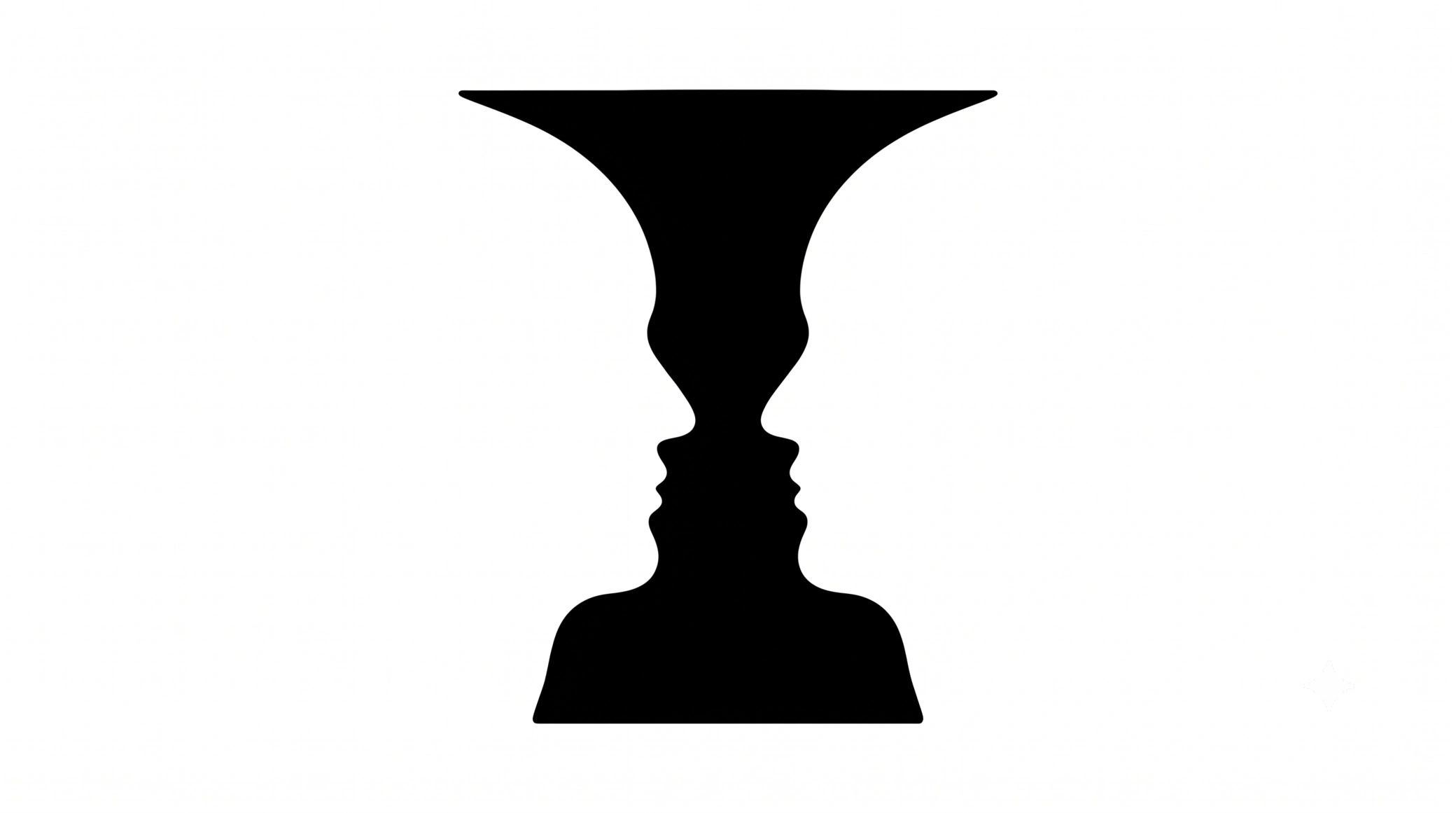
Are you looking at an elegant black vase or the profiles of two people facing one another? The fascinating part is that both answers are correct, yet it's almost impossible to see both images at exactly the same time.
The Rubin Vase is one of the most famous optical illusions in history because it demonstrates that our brain doesn't simply interpret what we see—it also decides which part of an image deserves our attention. What appears to be a simple drawing is actually one of the clearest demonstrations of how human perception works.
What is the Rubin Vase?
The Rubin Vase is an optical illusion created from a simple black-and-white image.
If you focus on the black area, you'll see a vase or a goblet. If you shift your attention to the white space surrounding it, two faces in profile suddenly appear, looking directly at one another.
The image itself never changes. The only thing that changes is what your brain chooses to focus on.
This phenomenon is known as the figure-ground relationship, one of the fundamental principles of visual perception.
The story of Edgar Rubin
The illusion was created by Edgar Rubin, a Danish psychologist born in 1886 who became one of the leading researchers in the study of visual perception.
In 1915, he published this image as part of his research into the relationship between figure and background, a concept that would later become one of the foundations of Gestalt psychology.
Rubin observed that our brain automatically organizes visual scenes by separating a main object from its background. However, he discovered that some images allow both interpretations to compete for our attention.
His famous vase quickly became an icon of psychology because it demonstrated that perception depends not only on our eyes but also on the way our brain organizes visual information.
More than a century later, the Rubin Vase continues to appear in psychology textbooks, university courses, scientific research, and museums around the world as one of the best examples of how we perceive reality.
Why does our brain switch between a vase and two faces?
Whenever we look at a scene, our brain has to decide which elements are the main subject and which belong in the background.
Most of the time, this decision happens instantly and without us even noticing.
The Rubin Vase, however, creates a unique visual conflict. Both the vase and the two faces carry the same visual importance, so the brain cannot maintain both interpretations simultaneously.
As a result, our perception constantly shifts from one image to the other.
Perhaps the most fascinating aspect is that neither interpretation is wrong. Both have been present from the very beginning. The only thing that changes is where our attention is directed.
An illusion with applications far beyond psychology
Edgar Rubin's discovery has influenced much more than the study of perception. Today, the figure-ground principle plays an essential role in design, art, and visual communication.
Designers and artists use this concept to guide our attention and create images that remain memorable long after we've seen them.
Some of its most common applications include:
- Hidden-image logos. Brands such as FedEx, WWF, and NBC cleverly use negative space to conceal symbols that viewers often discover only after looking more closely.
- Advertising and posters. Many marketing campaigns rely on figure-ground illusions to surprise viewers. When people suddenly notice a hidden image, the advertisement becomes far more memorable.
- Art and illustration. Numerous artists create works with multiple visual interpretations. Depending on where you focus, the same image can transform completely without changing a single line.
- Photographers use contrast between subjects and backgrounds to guide the viewer's eye and create striking visual compositions.
- User interface design. In websites and mobile applications, clearly separating foreground elements from the background makes navigation more intuitive and reduces cognitive effort.
Muchas marcas utilizan este principio para crear logotipos que esconden figuras secundarias, consiguiendo que las personas descubran nuevos detalles cada vez que los observan.
What the Rubin Vase teaches us about the human mind
The Rubin Vase reminds us that perception involves much more than simply opening our eyes.
Our brain continuously interprets incoming information, selecting what it considers most important at any given moment.
This process allows us to understand the world quickly and efficiently, but it also means that two people may focus on completely different aspects of the very same image.
The illusion reminds us that reality is not always as objective as it seems. In many situations, our mind constructs one interpretation from several possible alternatives.
Perhaps that's why the Rubin Vase continues to fascinate people more than one hundred years after its creation. It doesn't simply switch our perception between a vase and two faces—it encourages us to reflect on the remarkable way our brain builds the world we experience.
Discover the Rubin Vase at the Museum of Illusions
Seeing a picture of the Rubin Vase is only the beginning. Experiencing this type of illusion in an environment designed to challenge your senses is something entirely different.
At the Museum of Illusions Madrid, you'll discover how seemingly simple images can challenge your perception and reveal the fascinating ways your brain interprets reality. Every exhibit invites visitors to question what they see while exploring the science of perception through fun, interactive experiences.
If you'd like to experience just how easily your brain can switch between two different realities without the image itself ever changing, a visit to the Museum of Illusions Madrid is the perfect opportunity to see this remarkable illusion firsthand.

