
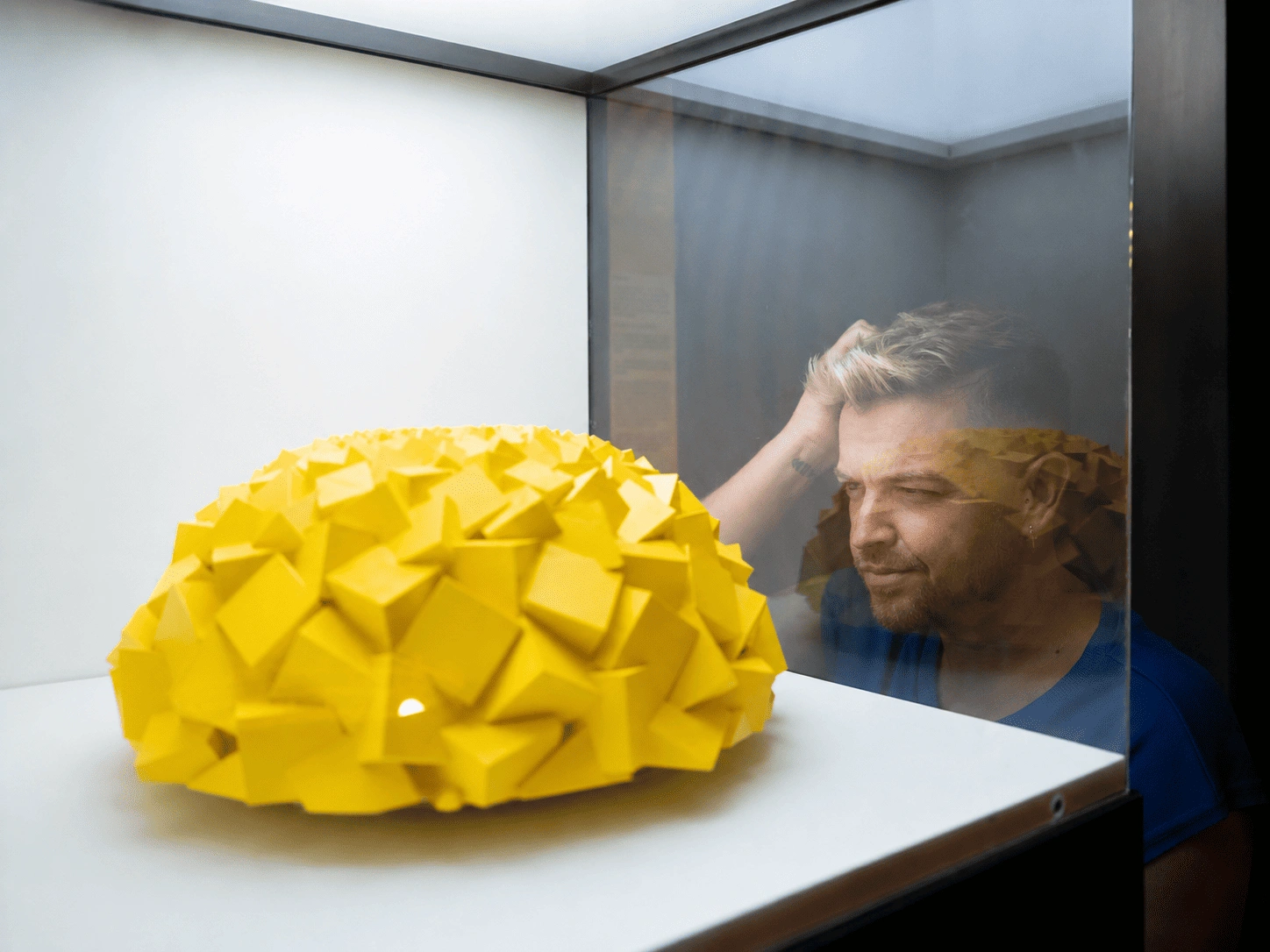
A figure spins rapidly in front of your eyes. Under a special light, the object seems to move, transform, or come alive as if it were a real animation.
And yet, there is no screen or video involved.
What you are seeing is a zoetrope, one of the most fascinating inventions in the history of optical illusions and one of the earliest predecessors of modern cinema.
What is a zoetrope?
A zoetrope is an optical device designed to create the illusion of movement using static images or figures.
Traditionally, it consisted of a spinning cylinder containing drawings placed in sequence. When rotated and viewed through small slits, the brain interpreted the images as continuous motion.
Today, much more advanced versions exist, where three-dimensional sculptures rotate under strobe lights to create astonishing movements that seem impossible.
Even though everything remains physically solid, the brain perceives a fully animated scene.
How does this optical illusion work?
The zoetrope effect is based on visual persistence and the way the brain processes rapid image sequences.
When several slightly different images appear one after another at high speed, the mind combines them into continuous motion.
In modern zoetropes, strobe lighting plays a key role. The light flashes at a precise speed while the object rotates, allowing the brain to perceive separate “frames.”
The result is a visual illusion where still figures appear to dance, run, or transform right in front of us.
Who invented the zoetrope?
The modern zoetrope was popularized in the 19th century by British mathematician William George Horner, although similar devices already existed before then.
His invention became one of the earliest machines capable of creating animation before cinema even existed.
Decades later, these visual principles helped inspire projectors, films, and animation techniques that transformed the way stories could be told through moving images.
That is why the zoetrope is considered one of the major ancestors of modern cinema.
The relationship between the zoetrope and the brain
The human brain does not process each image separately. Instead, it constantly connects visual information to create continuity and meaning.
The zoetrope takes advantage of this natural ability of the mind.
Although the eyes receive fragmented and individual images, the brain transforms them into smooth and coherent movement.
This illusion demonstrates that much of what we see depends not only on the eyes, but also on how the brain interprets time, light, and motion.
Zoetropes at the MOI
At the Museum of Illusions Madrid, visitors can discover how a completely static object can appear as a real animation thanks to the zoetrope effect and stroboscopic lighting.
The experience allows you to observe up close how the brain creates motion where there are actually only solid figures spinning rapidly.
It is one of the most hypnotic and surprising illusions in the museum because it combines art, science, and visual perception in a fully interactive way.
As you watch the effect, it becomes difficult to believe that everything you are seeing is simply a moving sculpture under flashing lights.