
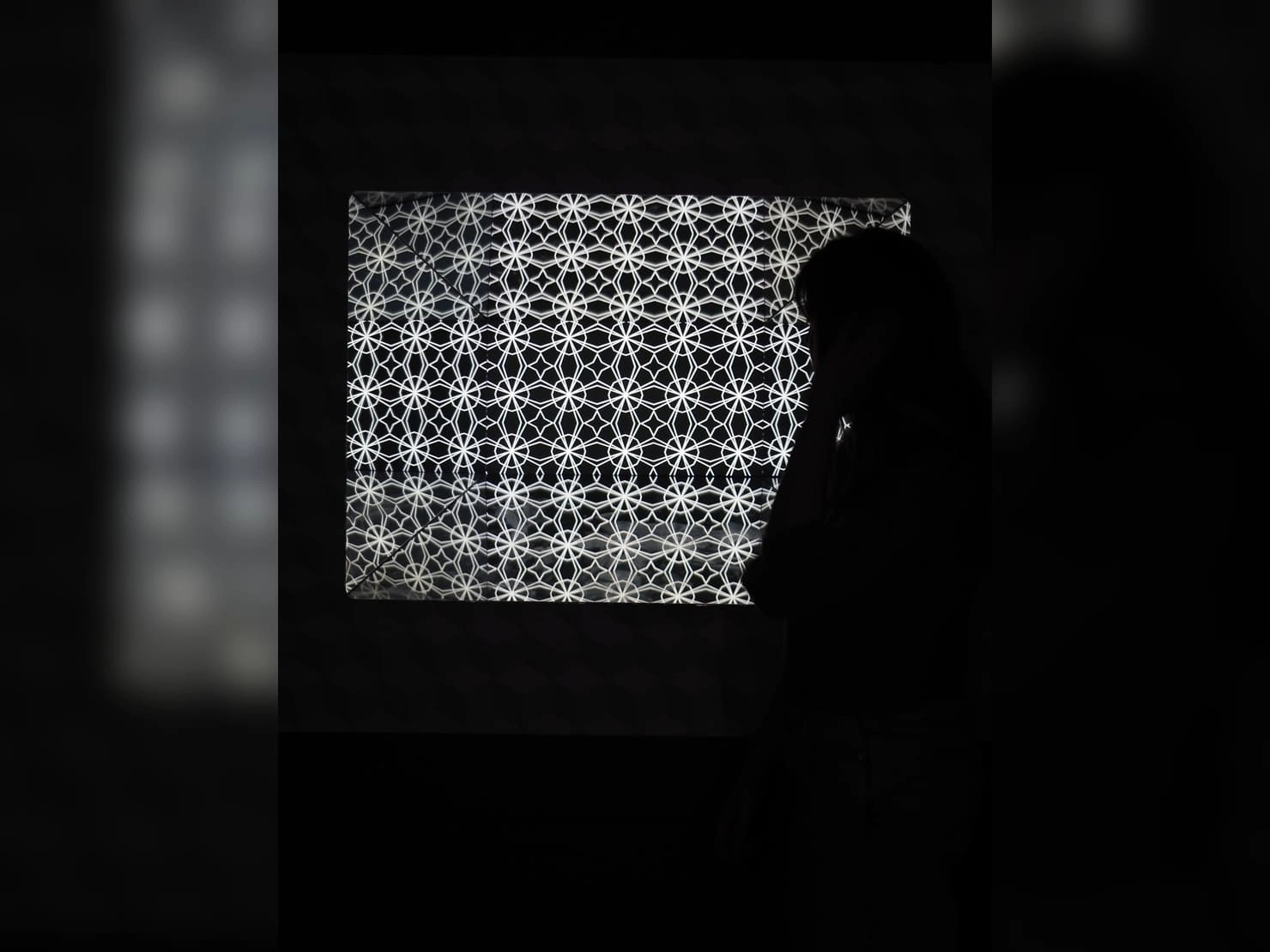
There are visual phenomena that appear when we least expect them.
A photograph that shows strange lines that were never part of the original scene. A striped shirt that seems to vibrate on a screen. A printed image where unexpected shapes emerge between the designs.
At first glance, they look like mistakes.
But in reality, they are a fascinating demonstration of how our perception works.
This phenomenon is known as the Moiré effect, a visual illusion that has intrigued artisans, scientists, and artists for centuries. What makes it so remarkable is that it does not require complex technology or elaborate tricks to appear. All it takes is something as simple as the overlap of two repetitive patterns.
And yet, the result is still capable of deceiving our eyes.
What is the Moiré Effect?
The Moiré effect is a visual phenomenon that occurs when two similar patterns overlap with a slight difference in size, angle, or spacing.
When this happens, new shapes appear that do not exist in either of the original patterns. These can take the form of waves, curved lines, geometric figures, or even the impression that an image is moving.
What makes it so intriguing is that nobody has actually drawn these shapes.
They are the result of the interaction between the patterns and the way our visual system interprets the information it receives.
That is why the Moiré effect is often considered an optical illusion. What we see appears real, but it is actually the result of a combination of elements that our brain transforms into something entirely new.
A story that began in textile workshops
Although today we associate the Moiré effect with screens, digital cameras, and graphic design, its origins go back much further.
The term comes from the French word moiré, which was used to describe certain silk fabrics that displayed shimmering, wave-like reflections similar to ripples on water.
During the 17th and 18th centuries, these textiles were highly valued for their changing appearance. Depending on the light or the viewing angle, the surface seemed to reveal different patterns and textures.
Artisans knew how to create the effect, but they did not yet understand the science behind it.
Long before the study of visual perception existed, these fabrics were already demonstrating that the human eye could interpret the same surface in different ways.
Who discovered the Moiré Effect?
Unlike many scientific discoveries, the Moiré effect cannot be attributed to a single person.
There is no specific inventor and no exact date that marks its discovery.
Instead, it is a phenomenon that was observed over centuries in different contexts. It first attracted attention in textiles, later in engravings and printed images, and eventually became a subject of study for mathematicians, physicists, and optical researchers.
Over time, scientists realized that the phenomenon depended not only on the patterns themselves but also on the way the human brain processes visual information.
That realization opened the door to a new understanding of optical illusions.
Ernst Mach and visual perception
Among the scientists who contributed to the understanding of these phenomena, Austrian physicist and philosopher Ernst Mach stands out.
During the late 19th century, Mach devoted much of his work to studying how we perceive shapes, contrasts, and visual information. His research helped demonstrate that human vision is not simply about recording what is in front of us—it is about interpreting it.
Our brains constantly analyze what we see, search for patterns, and organize information to create a coherent picture of the world.
Although Mach did not specifically study the Moiré effect as we know it today, his work was fundamental in explaining why certain combinations of lines and structures produce such striking visual effects.
Why does the Moiré Effect occur?
The explanation is closely linked to our ability to recognize patterns.
The human brain is highly specialized in detecting regularities. This skill allows us to recognize faces, read text, and quickly make sense of our surroundings.
However, when two repetitive structures overlap, that same ability can produce unexpected results.
Small differences between the patterns generate new visual frequencies that our perceptual system interprets as independent shapes. The result is the appearance of figures that seem to exist within the image, even though they are not actually part of it.
This is what makes the Moiré effect so fascinating from the perspective of visual perception.
It shows us that seeing is not always about capturing reality exactly as it is. More often, it is about interpreting the information we receive.
The Moiré Effect in photography
One of the fields where this phenomenon is most commonly encountered is photography.
It can appear when photographing fabrics, building facades, screens, or any surface with fine repetitive patterns.
In these situations, the details of the object interact with the pixel grid of the camera sensor, creating additional visual patterns.
As a result, photographs may display wavy lines or strange shapes that were not present in the original scene.
For years, camera manufacturers have developed technologies designed to reduce this effect and improve image accuracy.
The Moiré Effect in video and television
The phenomenon is also common in video and television.
Many people have seen it without realizing it had a name. It occurs when certain fabrics, stripes, or textures create visual interference when captured by a camera.
Surfaces may appear to vibrate or move slightly even though they remain completely still.
For this reason, television production teams have long avoided certain types of clothing and patterns during broadcasts.
The Moiré Effect in printing
Printing is another field where the Moiré effect has been extensively studied.
Printed images are often created using tiny dot patterns. When multiple screens or dot grids overlap at the wrong angles, secondary patterns can emerge and alter the final image.
To prevent this, printing professionals use precise alignment techniques and carefully control screen angles throughout the production process.
The Moiré Effect in clothing
Perhaps the most familiar example can be found in everyday clothing.
Certain striped fabrics or highly repetitive patterns can create visual waves when viewed from a distance or photographed.
It is such a common phenomenon that many people have experienced it without ever knowing its name.
And that is precisely what makes it so interesting.
It demonstrates that optical illusions do not exist only in laboratories or science books. They are part of everyday life.
What the Moiré Effect teaches us about perception
The Moiré effect is much more than a visual curiosity.
It is a reminder that our perception is not an exact copy of reality.
Every second, the brain interprets millions of visual signals to create a coherent understanding of the world. Most of the time, it does this with remarkable accuracy. But occasionally, phenomena like the Moiré effect reveal the hidden mechanisms behind the way we see.
Perhaps that is why it continues to fascinate us centuries after it first appeared in French silk fabrics.
Because it is not only about lines, patterns, or geometry.
It is also about us.
About the way we observe the world.
And about how some of the most surprising illusions emerge from the way our minds try to make sense of what they see.