
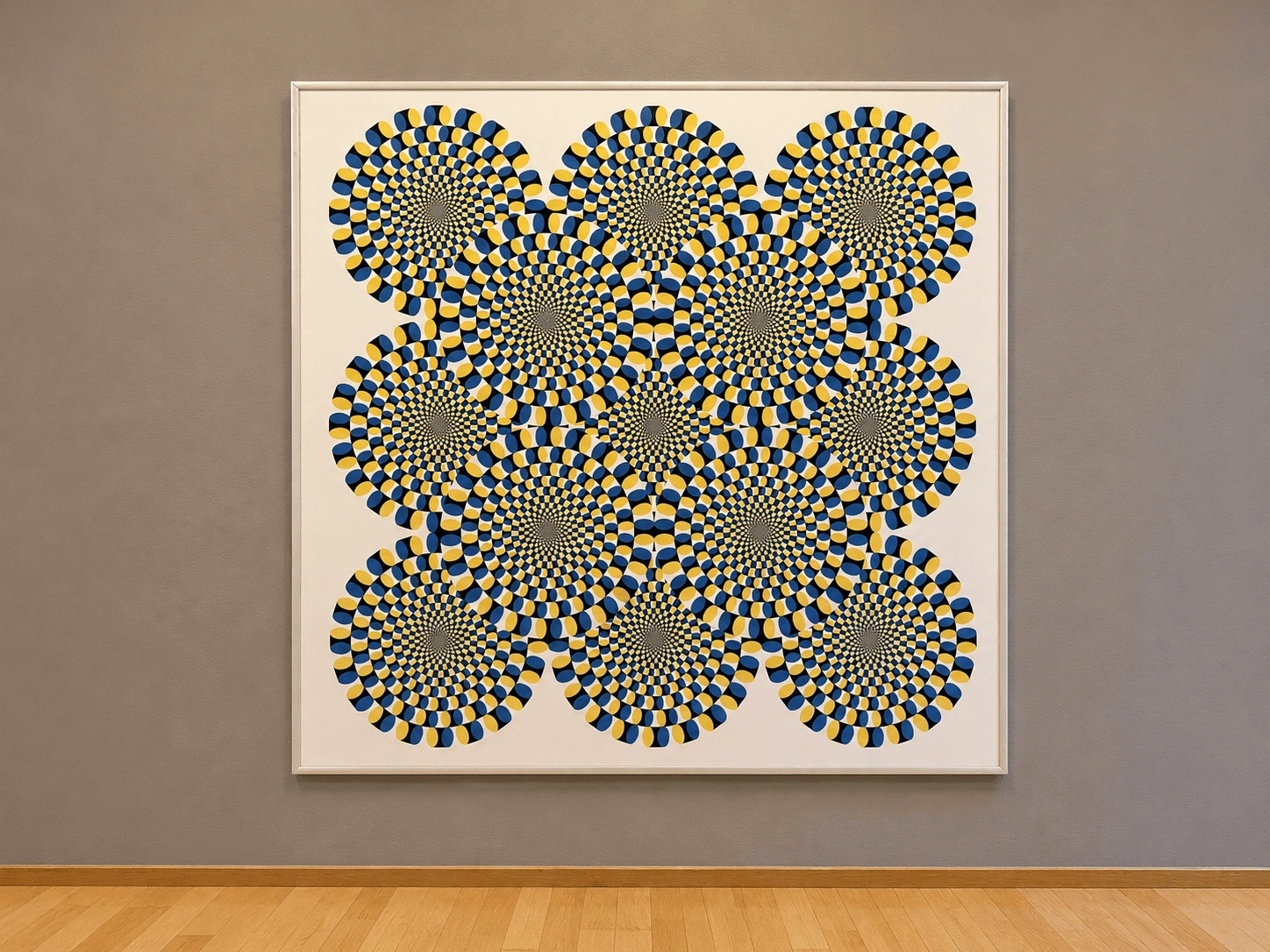
You take a step to the side… and the image appears to move with you. Change your position and suddenly it feels as though the object is turning, watching you, or even coming to life.
The wildest part? There's no real movement at all. It's the optical illusion of the moving image, and it happens entirely inside your head.
The trick lies in the color contrast and in the way your brain reads those patterns, creating a sense of motion where only a static image exists.
What is the moving image illusion?
The moving image illusion is exactly what it sounds like: a completely fixed figure or pattern that suddenly seems to shift, ripple, or vibrate right in front of you.
Even though the image doesn't move a single millimeter, your brain reads its color and luminance contrasts as if real movement were happening.
The effect comes from repeating shapes with very specific contrasts, designed to confuse your visual perception.
So even knowing it's a completely still drawing, your eyes will swear it's moving.
How this optical illusion works
Even if you don't notice it, your eye is never completely still. Even when you think you're staring at a fixed point, it makes tiny involuntary movements called microsaccades.
Combined with the pattern's color contrasts, those micro-movements send signals your brain reads as real motion.
The shapes and contrasts in this illusion are designed to do exactly that: confuse your brain into prioritizing motion that isn't there.
And even knowing the image is completely still, the visual sensation feels just as real.
Why your brain sees movement that isn't there?
Your brain is wired to detect movement before almost anything else. It's a survival mechanism: for thousands of years, missing something that moved could cost you dearly.
That's why it reacts automatically to certain patterns of contrast and color, even when there's absolutely no physical movement behind them.
This illusion takes full advantage of that: it combines colors, repeated shapes, and contrast to trigger that mechanism whether you like it or not.
The result is so convincing that it's hard to believe everything is, in fact, completely still.
The history of static motion illusions
This effect has been giving artists and scientists headaches for longer than you'd think.
Back in the 1960s and 70s, Op Art artists like Bridget Riley were already painting patterns and contrasts that seemed to vibrate and move on their own, without any real movement trick involved.
Later, vision perception researchers started studying the phenomenon seriously: they worked out exactly which combinations of color and shape trick the brain, and gave it a name: the "peripheral drift illusion".
The takeaway from all that research is as simple as it is unsettling: you don't see the world as it is, but as your brain believes it should look.
Moving image illusion at MOI
At the Museum of Illusions Madrid, you can see it with your own eyes: a completely still image that somehow seems to have a life of its own.
Step closer, step back, take your time looking. The longer you look, the clearer it gets that there's no physical trick behind it, just your own visual system playing tricks on you. It's one of those illusions that's even more surprising in person than in a photo.
The experience blends perception, play, and curiosity, in a space designed to make you stop trusting what you see.