
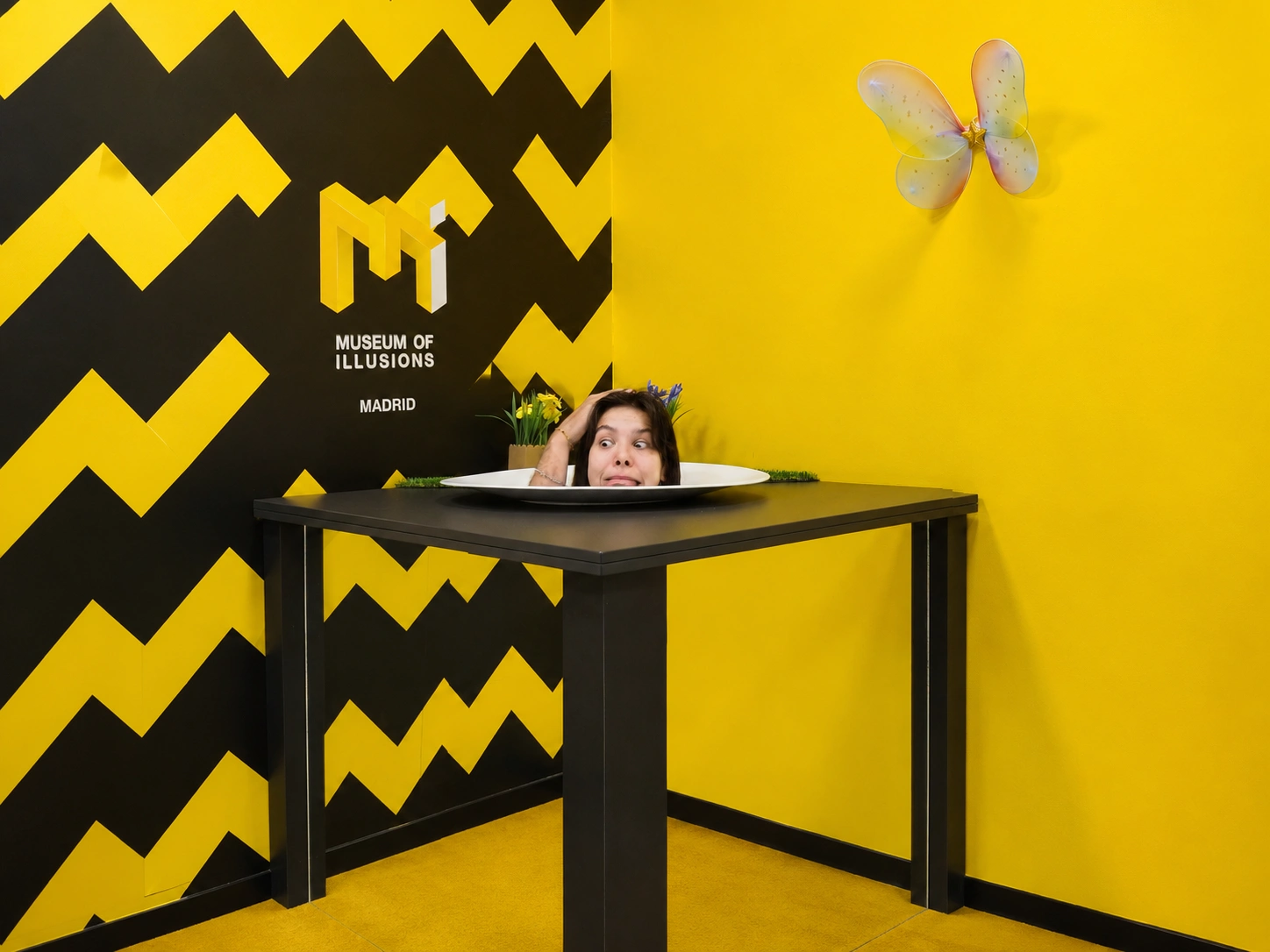
How can a static image appear to move? Why do two identical lines seem to have different lengths? And how can a room make you feel like you are losing your balance?
Many visual effects seem impossible at first glance, but they are actually illusions created through perspective, reflections, patterns, light, and visual perception.
At the Museum of Illusions Madrid, these effects become immersive experiences where the brain interprets reality in completely unexpected ways.
Moving circles
The circles appear to spin like a swirling vortex, even though the image is completely still.
The illusion is created through a combination of patterns, contrasts, and colors that trick the brain into perceiving movement where none actually exists.
The longer you look at the image, the stronger the effect seems to become. The brain interprets small visual contrasts as if something were truly moving in front of us.
This type of illusion demonstrates that motion perception does not depend only on physical movement, but also on how the brain processes visual information.
The Müller-Lyer illusion
In this famous optical illusion, two identical lines appear to have different lengths because of the arrows placed at their ends.
Even though both lines are exactly the same size, the brain interprets one as being farther away and automatically perceives it as longer.
The Müller-Lyer illusion is one of the best-known examples of how context can completely alter visual perception.
For more than a century, this effect has been used in studies related to perception, depth, and visual processing.
Other visual effects that challenge perception
In addition to these illusions, MOI Madrid features many other surprising visual experiences:
| Visual effect | What happens |
| Head on a platter | Hidden mirrors make it appear as though the body disappears and only the head remains. |
| Ambiguous cylinder | An object appears circular or rectangular depending on the viewing angle. |
| Color room | Lights and shadows completely change the perception of color. |
| Infinity room | Reflections create the sensation of endless space. |
| Rubin’s vase | You can see either a vase or two faces, but not both at the same time. |
| Eyes that follow you | The eyes appear to watch you as you move. |
| Magic prism | Reflections and projections create figures that seem to move or approach you. |
| Tilted room | The room completely alters your sense of balance and orientation. |
| The black dot | Part of the image seems to disappear when staring at a central point. |
| Beuchet chair illusion | People appear giant or tiny depending on perspective. |
| Hollow face illusion | A mask appears to follow your movements even while remaining still. |
Experience these visual effects at MOI
At the Museum of Illusions Madrid, you can experience all these visual effects firsthand and discover how science can feel like real magic.
The installations combine mirrors, lights, perspective, and perception to create immersive experiences where each room challenges your senses in a different way.
From infinite reflections to impossible rooms and mind-bending visual effects, the museum offers a fun, original, and interactive experience where every space is designed to surprise visitors, play with perception, and reveal how the brain can interpret reality in completely unexpected ways.