
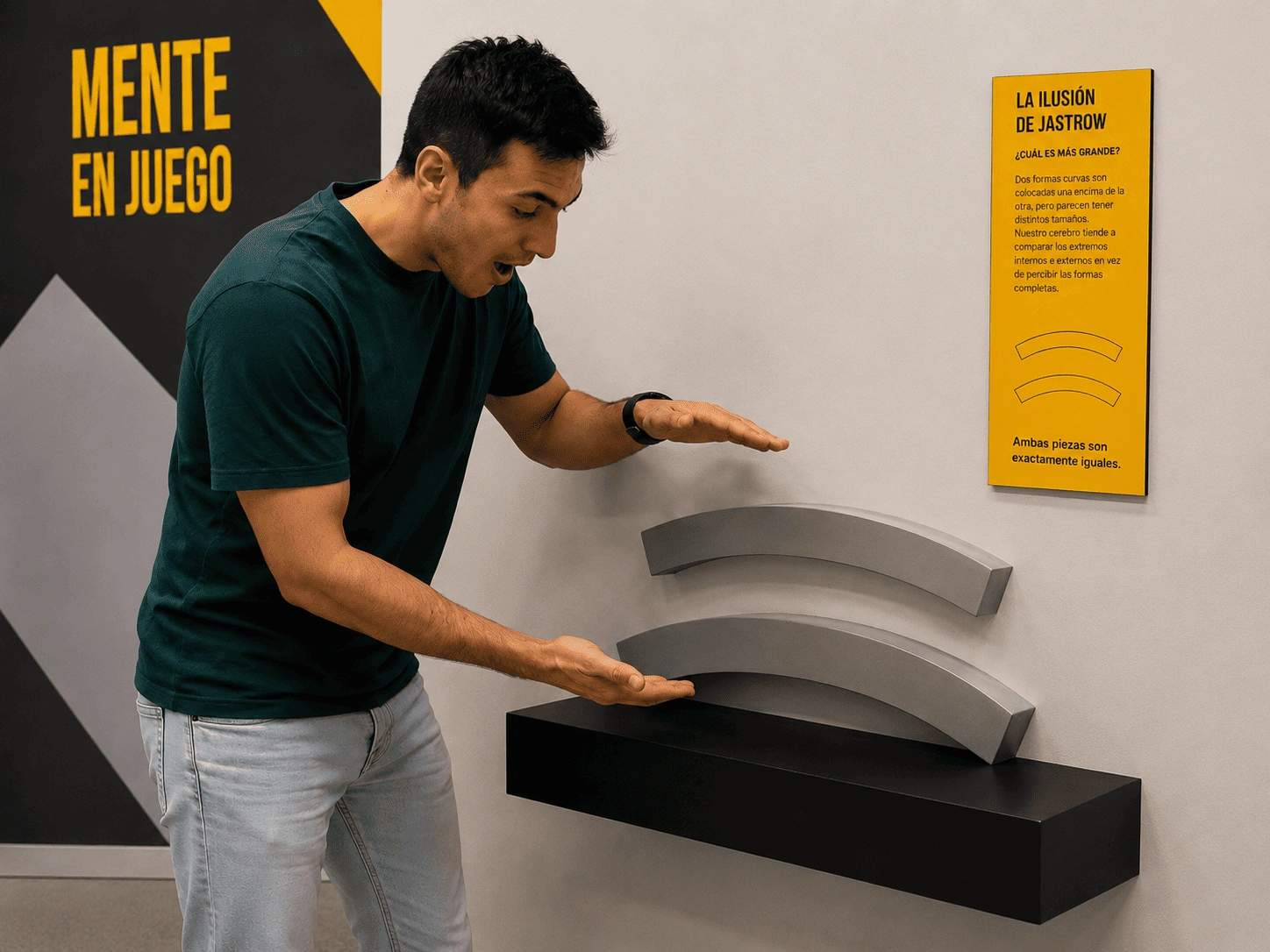
Have you ever compared two objects that seemed completely different in size, only to discover they were actually identical? It may sound impossible, but your brain is capable of making exactly that mistake.
The Jastrow illusion is one of the most surprising optical illusions because it uses two identical shapes to convince us that one is noticeably larger than the other. Like many famous visual illusions, it reminds us that perception is not simply about seeing—it is about how our brain interprets what our eyes observe.
What is the Jastrow Illusion?
The Jastrow illusion consists of two identical curved shapes, often compared to railway tracks, boomerangs, or slices of a ring.
This simple experiment reveals one of the brain's most fascinating characteristics: our perception depends heavily on context.
When one shape is placed directly beneath the other, the lower one appears larger, longer, or wider, even though both are exactly the same size.
The illusion is so convincing that many people refuse to believe the shapes are identical until they physically place one on top of the other.
The story of Joseph Jastrow
The illusion is named after Joseph Jastrow, an American psychologist born in 1863.
Jastrow was one of the pioneers of experimental psychology in the United States and dedicated much of his career to studying perception, attention, and the way our minds process information.
He introduced this illusion in 1892 while investigating how visual comparisons could influence our judgment. Rather than proving that our eyesight was unreliable, Jastrow wanted to demonstrate that the brain constantly interprets visual information instead of recording it objectively.
His research became highly influential, helping establish the scientific study of perception and inspiring generations of psychologists and neuroscientists.
Today, the Jastrow illusion remains one of the best-known demonstrations of how easily our brains can be fooled.
Why does the Jastrow Illusion fool us?
Unlike many optical illusions that rely on perspective or depth, the Jastrow illusion works because our brain compares neighboring edges rather than entire objects.
When the two curved shapes are placed together, the longer outer edge of one sits next to the shorter inner edge of the other. Instead of comparing the complete figures, our visual system focuses on these adjacent edges, making one shape appear larger.
This happens automatically and almost instantly.
Even after learning that both pieces are identical, many people continue to perceive one as being bigger. Knowing the truth does not always change what we see.
The illusion highlights an important fact about human vision: our brain prioritizes speed over perfect accuracy.
Where can we find the Jastrow Illusion?
Although it may appear to be a laboratory experiment, the same visual principles influence many aspects of everyday life.
Designers, architects, artists, and psychologists have long been interested in how context affects perception.
The ideas behind the Jastrow illusion can be seen in:
- Graphic and product design.
- Architecture and interior spaces.
- Advertising and visual communication.
- Educational demonstrations about perception.
- Cognitive psychology and neuroscience research.
Understanding these visual effects helps professionals create designs that are easier to understand, more visually balanced, and more engaging.
What does the Jastrow Illusion teach us?
The Jastrow illusion reminds us that seeing is not the same as measuring.
Every second, our brain interprets enormous amounts of visual information. To process it efficiently, it relies on shortcuts, comparisons, and previous experiences.
Most of the time, those shortcuts help us navigate the world quickly and accurately. Occasionally, however, they create fascinating errors that reveal how perception really works.
Rather than exposing weaknesses in our vision, illusions like this demonstrate just how sophisticated the brain truly is. They allow scientists to study the hidden processes that shape every image we experience.
Experience the Jastrow Illusion at the Museum of Illusions
Looking at a picture of the Jastrow illusion is fascinating, but experiencing it in person makes its effect even more surprising.
At the Museum of Illusions Madrid, you'll discover visual illusions that challenge your perception and reveal how your brain constructs reality. Exhibits like the Jastrow illusion invite visitors of all ages to question what they see, explore the science behind perception, and enjoy interactive experiences that make learning unforgettable.
Whether you're passionate about psychology, curious about optical illusions, or simply looking for an original activity in Madrid, experiencing these illusions firsthand offers a completely new way to understand how your mind works.

