
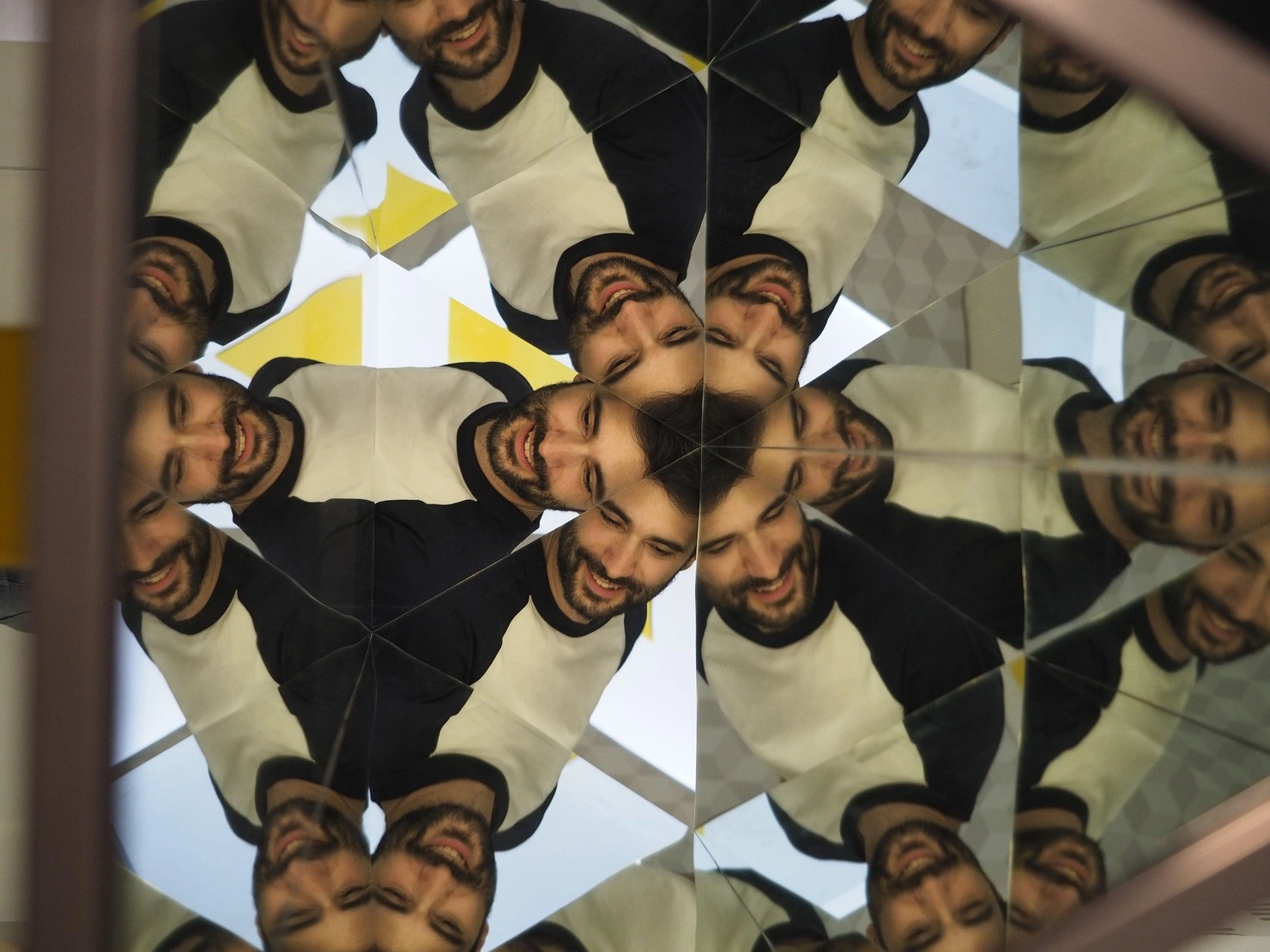
A kaleidoscope may seem like a simple object: a tube, a few mirrors and small fragments of color. But the moment you look through it, everything changes. What was once just a handful of pieces becomes an endless pattern of shapes, reflections and symmetry.
This optical illusion continues to fascinate us because it shows something very simple: our brain does not just see reality, it also interprets it.
What is a kaleidoscope?
A kaleidoscope is an optical instrument made up of several mirrors placed at an angle inside a tube. At one end, it usually contains small crystals, beads or colored pieces.
When light enters and bounces off the mirrors, those objects are reflected many times. The result is a symmetrical image that changes every time we turn the kaleidoscope.
What matters is not only what we see, but how we see it. Our brain organizes the reflections as if they formed a complete image, even though everything actually comes from just a few repeated pieces.
The history of the kaleidoscope
The modern kaleidoscope was invented in 1817 by Sir David Brewster, a Scottish physicist who studied the behavior of light and mirrors.
Although today we associate it with play, it was born as a scientific experiment. Its name comes from Greek and means something close to “observing beautiful forms”.
Over time, it moved from laboratories into homes and became one of the best-known optical toys in the world. Its success makes sense: it explains science in a visual, simple and surprising way.
How this optical illusion works
The kaleidoscope works through reflection. When light reaches a mirror, it bounces back. If several mirrors are placed at an angle, the image repeats again and again.
Usually, the mirrors are positioned at angles that create symmetrical patterns. When you move the tube, the pieces inside change position and the reflections generate new figures.
That is why no turn looks exactly the same as the one before.
The trick is not only in the mirrors. It is also in the brain. Our mind looks for order, recognizes patterns and turns reflections into a coherent image. That is why the kaleidoscope feels so hypnotic.
When the kaleidoscope looks outward
There is a variant that surprises in a different way: the teleidoscope.
Instead of enclosing colored pieces inside, it replaces those beads with a lens or a translucent sphere. It no longer multiplies a handful of fixed fragments, but everything in front of it: a street, a plant, a familiar face.
Looking through a teleidoscope is, in essence, looking at the real world through the same mirrors that multiply colors in a classic kaleidoscope. The source of the image changes, but the effect does not: we still see symmetry where there was only an everyday scene before.
It's a good reminder of something that repeats across almost every optical illusion: you don't always need to change what you're looking at. Sometimes it's enough to change the tool you're looking through.
Why kaleidoscopes fascinate us
We like them because they combine change and order. Each image is different, but they all seem balanced. There is movement, color and symmetry.
The human brain also tends to enjoy patterns. We look for them in clouds, tiles, shadows and also in reflections. The kaleidoscope takes advantage of that natural tendency and turns it into a visual experience.
It is a simple way to understand how perception works: sometimes you do not need to change reality, you only need to change the angle from which you look at it.
Kaleidoscopes and mirrors at the Museum of Illusions Madrid
At the Museum of Illusions Madrid, mirrors play a leading role in many experiences. Just like in a kaleidoscope, images duplicate, transform and play with perception.
The difference is that here you do not just look at an illusion: you step inside it.
The museum’s rooms and experiences show how light, perspective and reflections can trick the brain in a fun way, from the kaleidoscope to the holograms, which play with light in a completely different way. It is a visual way to learn science without feeling like you are in a classroom.
That is why it is one of those plans in Madrid that works well for families, friends, couples, tourists and school groups alike. It brings together leisure, curiosity and photography in a single visit.
An original plan to understand your brain
The kaleidoscope is a good gateway into the world of optical illusions. It shows that what we see depends on light, mirrors, position and the brain’s interpretation.
And that is exactly what happens with many of the museum’s illusions: they seem impossible, but they have an explanation.
If you are looking for an original activity in Madrid, the Museum of Illusions offers something different: a chance to observe, play and discover why your mind can surprise you, even with something as simple as a reflection.
Get your tickets in advance and discover how many ways to see the world fit inside a single museum.