
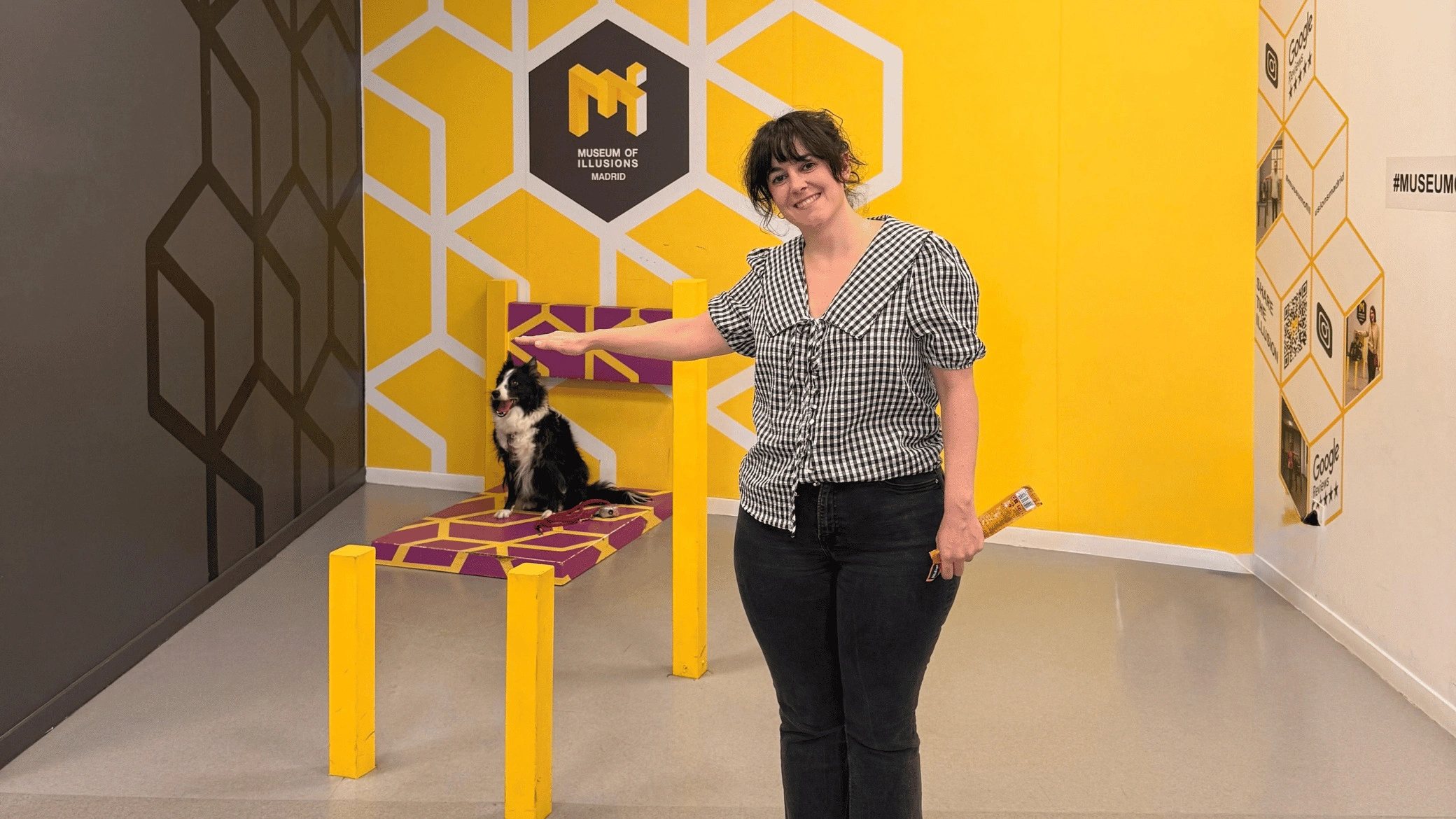
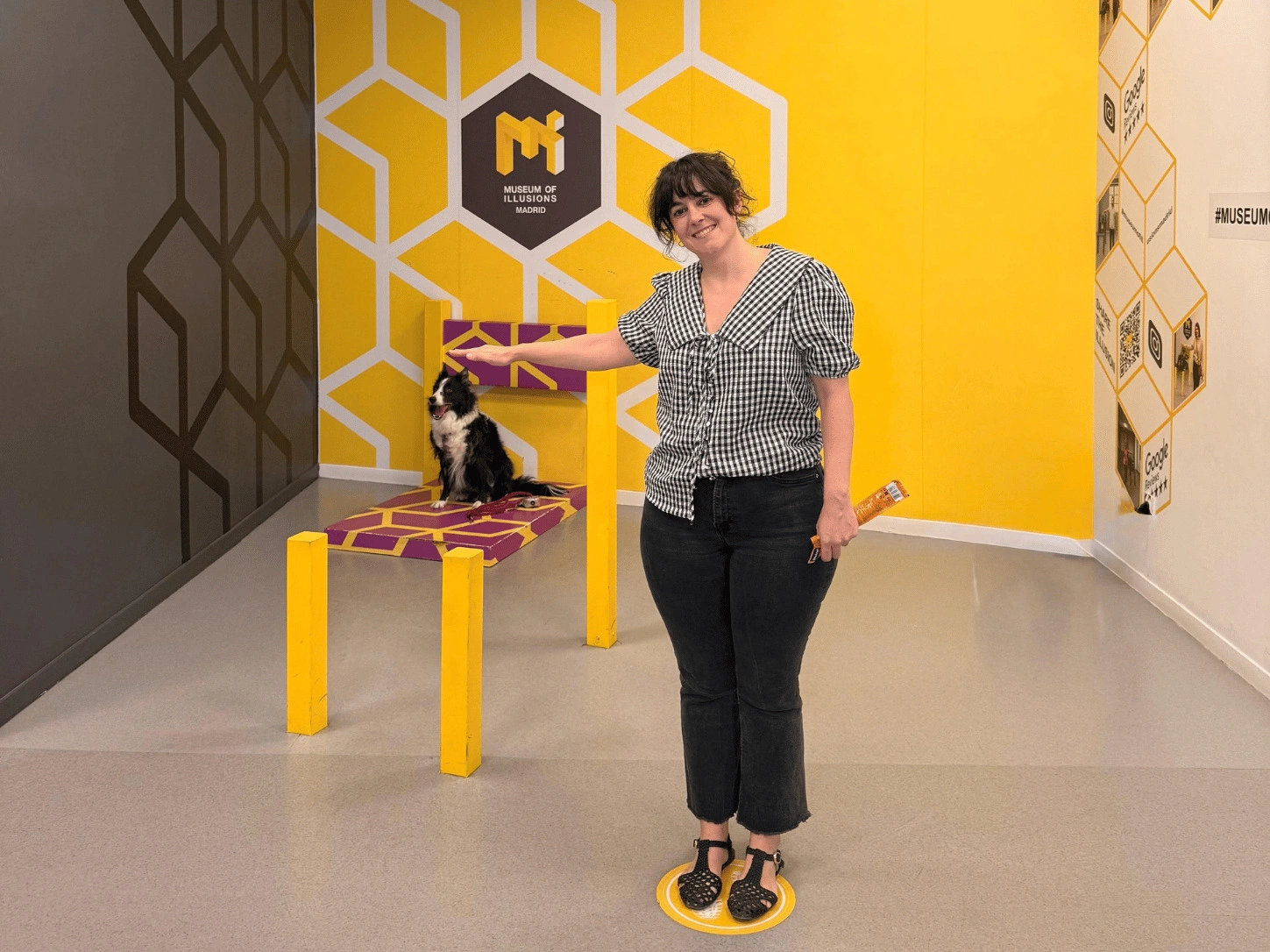
Some chairs are just for sitting on. And then there's one that can make you look tiny, or turn the person next to you into a giant.
It's the Beuchet chair, a perspective-based optical illusion that shows something surprising: our brain doesn't judge the size of objects in isolation. It uses distance, context and everything around them to decide what we're seeing.
That's why two people of similar height can look completely different in size in a photo.
And no, nobody has shrunk.
What is the Beuchet chair?
The Beuchet chair is a forced perspective illusion created by French psychologist Jean Beuchet in 1963 to study how we interpret size and distance.
At first glance it looks like an ordinary chair. In reality, it's made up of separate parts placed at different distances from the viewer.
From the right spot, those pieces line up visually and our brain reads them as a single object.
That's where the trick begins.
A person standing further away appears to be sitting on a chair that our brain believes is much closer. As a result, it reads them as extraordinarily small next to someone standing in the foreground.
How does the Beuchet chair illusion work?
The effect mainly combines three things: forced perspective, depth perception and apparent size.
When we look at a scene, the brain uses different cues to work out how far away each object is. One of them is comparing its size with familiar things.
And few things are as familiar to us as a chair.
If the different parts of the chair are perfectly aligned from one specific point, our brain assumes they form a single object and are all at the same distance.
But they're not.
The person who looks tiny is actually much further away.
Photography makes the effect even stronger, because the camera captures the scene from a single viewpoint and removes many of the depth cues we get when we move or use both eyes.
That's why simply stepping away from the right spot is enough for the trick to start falling apart.
Why does our brain fall for it?
Because most of the time, it works.
Our visual system has to quickly make sense of a three-dimensional world using the information that reaches our eyes. To do that, it relies on rules learned over a lifetime.
One of them is size constancy: even though a person far away casts a smaller image on our retina, we know they haven't shrunk.
The Beuchet chair manipulates exactly those references.
The brain receives conflicting information about distance and size, and ends up building the interpretation it considers most logical: a normal chair with an incredibly small person sitting on it.
The illusion doesn't change anyone's size.
It changes the cues our brain uses to work it out.
An illusion also used in film and photography
Forced perspective doesn't only belong in museums of illusions.
The same principle has been used for decades in photography, film, television, advertising and set design to change the apparent size of people and objects without changing their actual size.
Someone standing very close to the camera can look huge next to someone further back. Scale models can pass for real buildings, and a small set can become a much larger scene if the viewpoint is carefully controlled.
Similar principles also appear in architecture and interior design, where perspective, proportions and sightlines can make a room look deeper, taller or more spacious.
The Beuchet chair lets you experience this in a particularly simple way: just change position and see how your perception changes too.
The photo everyone wants to try
At the Museum of Illusions Madrid, the Beuchet chair makes visitors part of the experiment.
One person takes one position and another stands on the opposite side. The camera does the rest.
The screen shows something impossible: a giant next to a tiny person.
That's why it's one of those interactive installations that make much more sense when you take part than when you just watch.
And it's not the only experience where your viewpoint completely changes what you see.
- In the Upside-Down Room, the camera angle can make it look as if you're walking on the ceiling.
- In the Vortex Tunnel, something different happens: the surroundings spin while the floor stays still, and what you see clashes with what your body feels.
Three different experiences with one thing in common: they show that seeing and understanding what we see aren't always quite the same thing.
Where can you see the Beuchet chair in Madrid?
You can try the Beuchet chair at the Museum of Illusions Madrid, along with other optical illusions and installations based on perspective, reflections, movement and perception.
It's especially fun if you're looking for things to do in Madrid with kids, but it also works as a plan with friends, as a couple, or for anyone who enjoys finding out why their own eyes can fool them.
If you want to keep testing your perception afterwards, discover more
visual effects that look like magic.
Next time you see the photo, look closer
The first thing you'll probably notice is the difference in size between the two people.
But the really interesting part is what's behind it.
The Beuchet chair shows that our brain doesn't just record what's in front of it: it constantly interprets, compares and fills in the information it receives.