
You're driving down a road in the middle of summer and, in the distance, the asphalt gleams as if there were a puddle. You get closer, but the water disappears.
The wildest part? You didn't imagine it: your eyes really did see something, just not what you thought.
This is a mirage, one of those visual phenomena that prove light doesn't always travel in a straight line.
What is a mirage
A mirage is an optical phenomenon that happens when light bends as it passes through layers of air at different temperatures.
Near the ground, hot air is less dense than the cooler air above it. As light moves from one layer to another, it bends slightly instead of traveling straight.
Your brain doesn't know the light has bent: it sticks to its usual rule and assumes light travels in a straight line. That's why it reads what you see as if it were coming from the ground, like a reflection, even though it's actually the sky.
Mirages aren't just a desert thing
When we think of mirages, we usually imagine sand, heat, and a distant horizon. But they can also appear in much more everyday places.
In Madrid, for example, a very sunny avenue in August is enough for the ground to seem to shine in a strange way. You don't need to be in the middle of the desert. All it takes is a hot surface, air at different temperatures, and light traveling at the right angle.
There are also mirages at sea. Sometimes, ships appear to float above the horizon or look distorted. In cold areas, the opposite can happen than on asphalt: the air layers make distant objects seem elevated, stretched, or closer.
For centuries, these images fueled legends about ghost cities, impossible islands, or ships suspended in the sky. Today we know the explanation lies in physics, but that doesn't take away its charm.
Perhaps it even adds to it.
What happens between the eye and the brain
Sight doesn't work like a simple window open to the world.
The eye gathers light. The brain builds an interpretation.
To do that, it uses cues: shadows, contrast, depth, lines, size, apparent motion, and past experience. With all of that, it puts together a coherent version of what's in front of you.
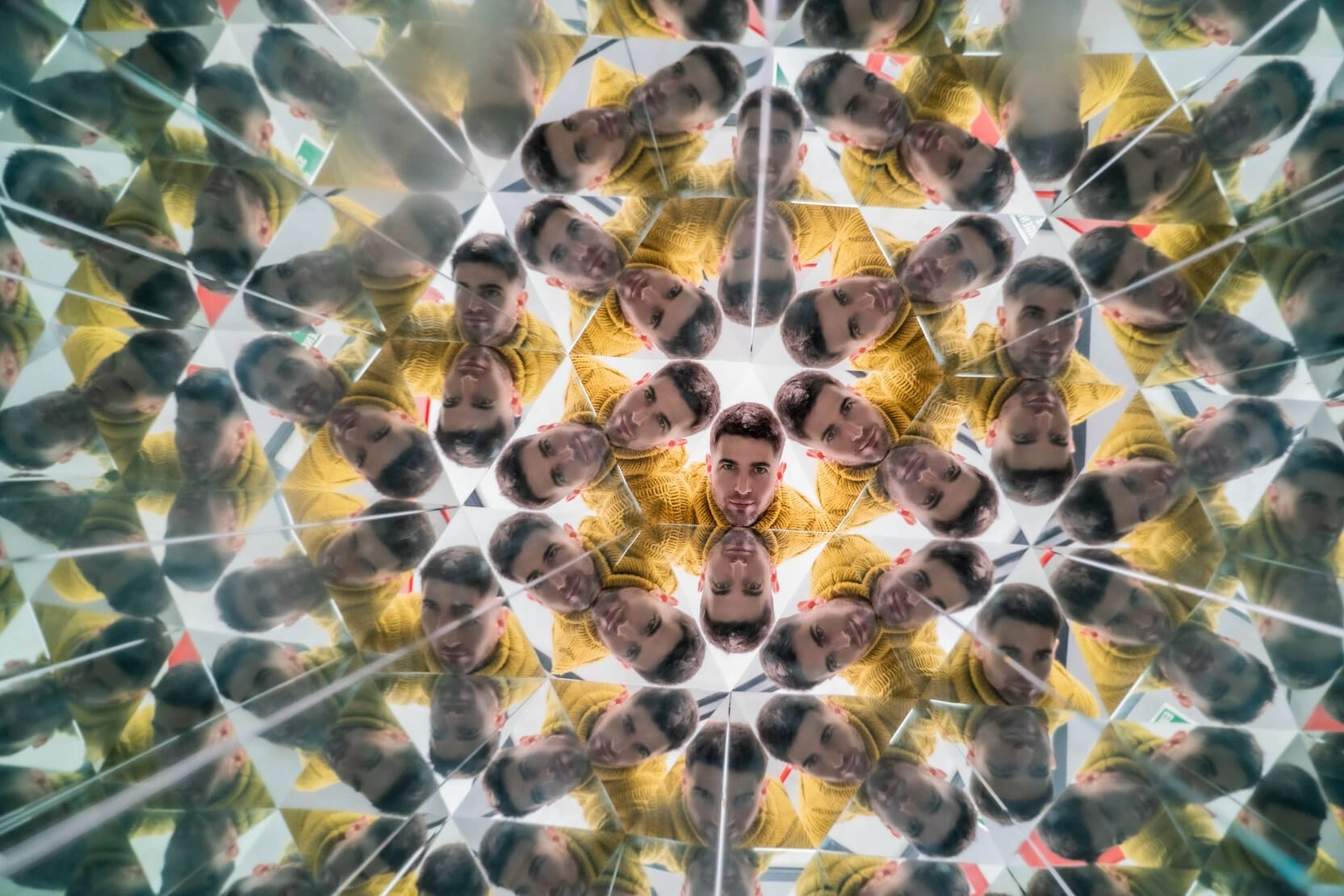
In a mirage, it receives a light signal that seems to come from the ground and reads it as a reflection. In other illusions, it tries to make sense of overlapping or repeating patterns, and ends up perceiving shapes that were never really there.
It's not some absurd glitch. It's the same system that helps you recognize a face in a crowd, judge a distance before crossing the street, or read a word even when a letter is missing.
Illusions appear when that highly efficient system runs into ambiguous information.
Why we find visual illusions so appealing
We like them because they place us in an uncomfortable and fun place at the same time.
We know an image isn't moving, but we see it move. We know there's no water on the asphalt, but the reflection keeps appearing. We know a room is stable, but the body reacts as if something didn't fit.
That contradiction awakens curiosity.
And it also returns us to a more childlike way of looking, in the best sense. That way of asking "How can this be?" before seeking a logical answer.
Optical illusions have this power: they turn science into a close experience. They don't start with a theory, but with a surprise.
Experiencing perception in Madrid
There are phenomena that are better understood when experienced.
Reading about mirages can be interesting, but feeling how your perception becomes disoriented is another thing. That's why spaces like the Museum of Illusions in Madrid connect so well with people of very different ages.
There, perception isn't explained only with words. It's lived in rooms that play with perspective, balance, reflections, size, and apparent movement.
A tunnel can make you feel that everything is spinning even though you know you're standing still. An installation can alter the proportion of bodies. An image can change depending on the point from which you look at it. A reflection can multiply a scene until it becomes something unexpected.
It's not about finding "the trick" too quickly. Part of the experience is in letting yourself be surprised for a few seconds.
A plan that starts with a question
Among so many plans in Madrid, there are some that are remembered because they break routine. They don't need to be complicated. Sometimes it's enough to enter a place where the normal stops behaving as you expected.
That happens with optical illusions: they function as a game, but also as a simple way to understand how the mind works.
For children, they awaken questions. For adults, they break certainties. For friends or couples, they create that shared moment where everyone looks at the same thing and no one quite explains it the same way.
Mirages remind us that reality doesn't always change. Sometimes our way of looking at it does.
If you want to check it out for yourself, you can discover it at the Museum of Illusions in Madrid, among immersive experiences, logic games, and installations that turn perception into a surprise.

