
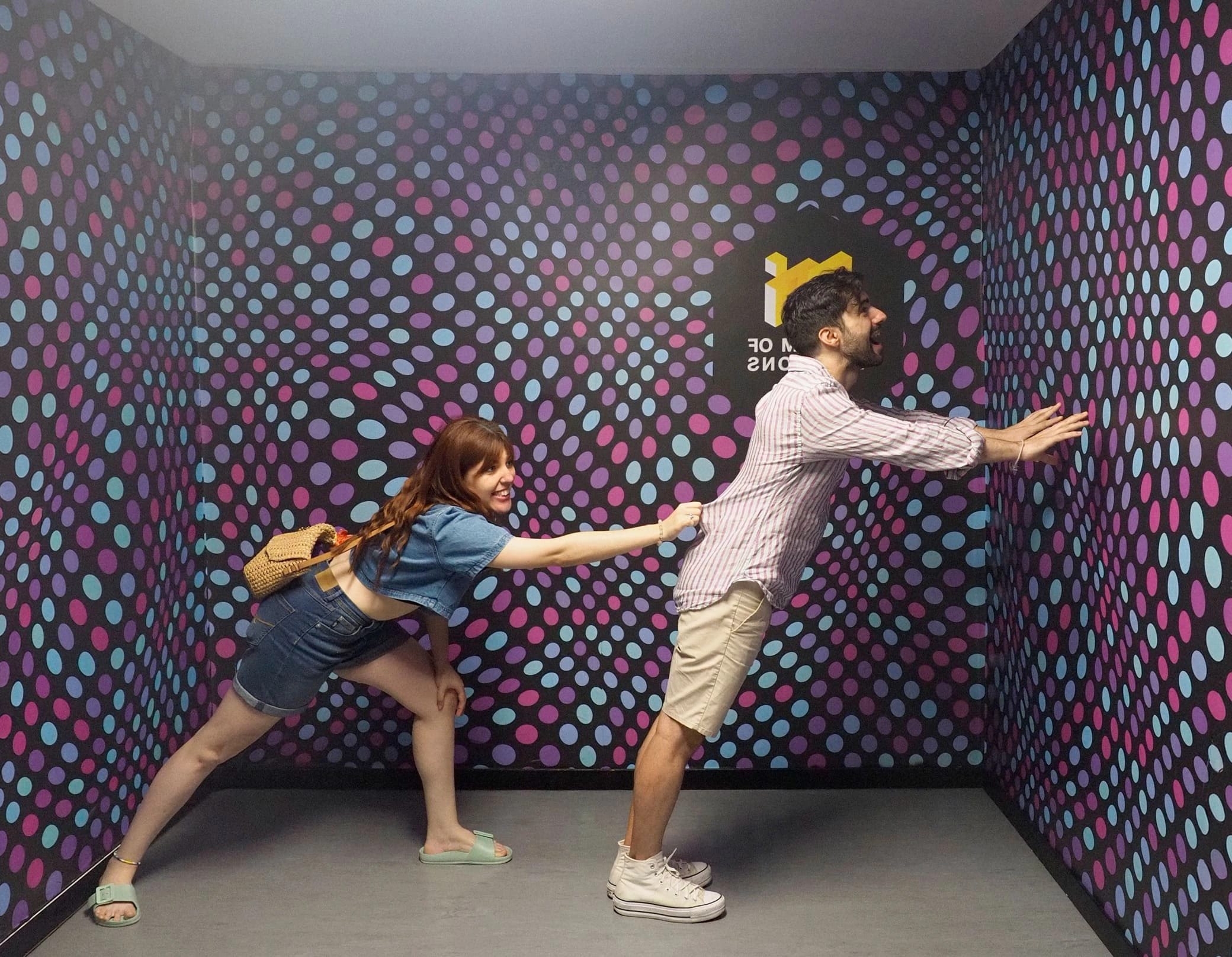
You walk into a room and, within seconds, something doesn't add up.
You know you're standing up, your legs seem to agree and yet your body starts leaning, almost before you can stop it.
The tilted room plays on a curious conflict: what your eyes see and what your body feels aren't telling quite the same story.
What is a tilted room?
A tilted room is a space where the walls, floor, furniture and other visual cues are angled in a way that changes how we perceive what's actually vertical or horizontal.
Our brain is constantly using the lines around us to get its bearings.
Normally that works: walls are vertical, the floor is horizontal and objects rest on it.
But if those references are tilted in a controlled way, the visual system can start treating them as if they were correct.
And that's when a strange feeling kicks in: we know our body should be upright, but the room is telling us something else.
An experiment that began in 1948
This effect didn't start out as an attraction.
In 1948, psychologists Solomon Asch and Herman Witkin carried out a series of experiments to study how we decide what being truly "upright" means.
Participants looked into a small tilted room and had to set a rod in a vertical position.
The result was surprising: the tilt of the room could significantly shift what people perceived as vertical. In some cases, the visual surroundings were so influential that they even changed how people perceived the orientation of their own body.
That work led to later experiments such as the rod-and-frame test, used to study how much we rely on visual cues from our surroundings to orient ourselves.
Why can we lose our balance?
Staying on our feet doesn't depend on a single sense.
The brain combines information from three main systems:
- Vision, which provides cues about our surroundings;
- The vestibular system, located in the inner ear, which detects head movement and orientation;
- Proprioception, which reports the position of our muscles and joints.
Normally these signals agree.
In a tilted room, they may stop doing so.
The eyes receive one set of cues while the inner ear and the body provide another. The brain has to decide which information to trust more, and that can lead to a feeling of leaning, unsteadiness or even dizziness.
This process is known as multisensory integration: the brain combines different signals to build a single perception of where we are and how our body is oriented.
Why do we trust what we see so much?
Because our visual surroundings are usually an extremely reliable reference.
In everyday life, walls, doors, buildings and horizons give us constant clues about which way is up and which way is down.
Experiments with tilted rooms showed exactly how far those clues can change our perception of vertical.
Differences between people have even been observed: some rely more on the visual frame than others to orient themselves.
That's why two visitors can walk into the same room and feel the effect with different intensity.
From the tilted room to car sickness
This kind of conflict between the senses also happens outside museums.
A very everyday example is reading in a car.
Your eyes are focused on a page or screen that's almost completely still, while your inner ear picks up bends, acceleration and braking.
The mismatch between visual and vestibular signals is one of the most widely studied explanations for motion sickness.
The setting changes, but the idea is similar: the brain receives information that doesn't quite fit together.
Virtual reality takes the conflict even further
With a virtual reality headset, the exact opposite can happen.
Your eyes perceive that you're moving forward, turning or falling, while your body stays completely still.
That mismatch can contribute to what's known as cybersickness, which can cause disorientation, discomfort or nausea. Current research sees the integration of visual, vestibular and proprioceptive signals as one of the key factors in understanding it.
That's why these principles are taken into account when designing virtual reality, video games, simulators and other immersive experiences.
Understanding how we combine vision and balance makes it possible both to create a sense of movement and to try to stop that experience from ending in dizziness.
Do the tilted room and the Vortex Tunnel work the same way?
Not exactly.
And the difference is worth understanding.
In the tilted room, static visual cues change our perception of vertical and of our body's position.
In the Vortex Tunnel, on the other hand, the movement of our visual surroundings can create a much stronger sense that we're the ones leaning or spinning.
Both experiences pit our eyes against other bodily signals, but they do it in different ways.
Discover the tilted room at the Museum of Illusions
At the Museum of Illusions Madrid, the tilted room lets you experience first-hand something psychologists have been studying for decades: how visual cues can change our perception of orientation and balance.
It's part of a visit that includes other optical illusions and experiences that test the relationship between what we see and what we think is happening.
And perhaps that's the most interesting thing about the tilted room.
It doesn't make us forget where the floor is.
It shows that to know where it is, our brain has to reach an agreement with itself.