
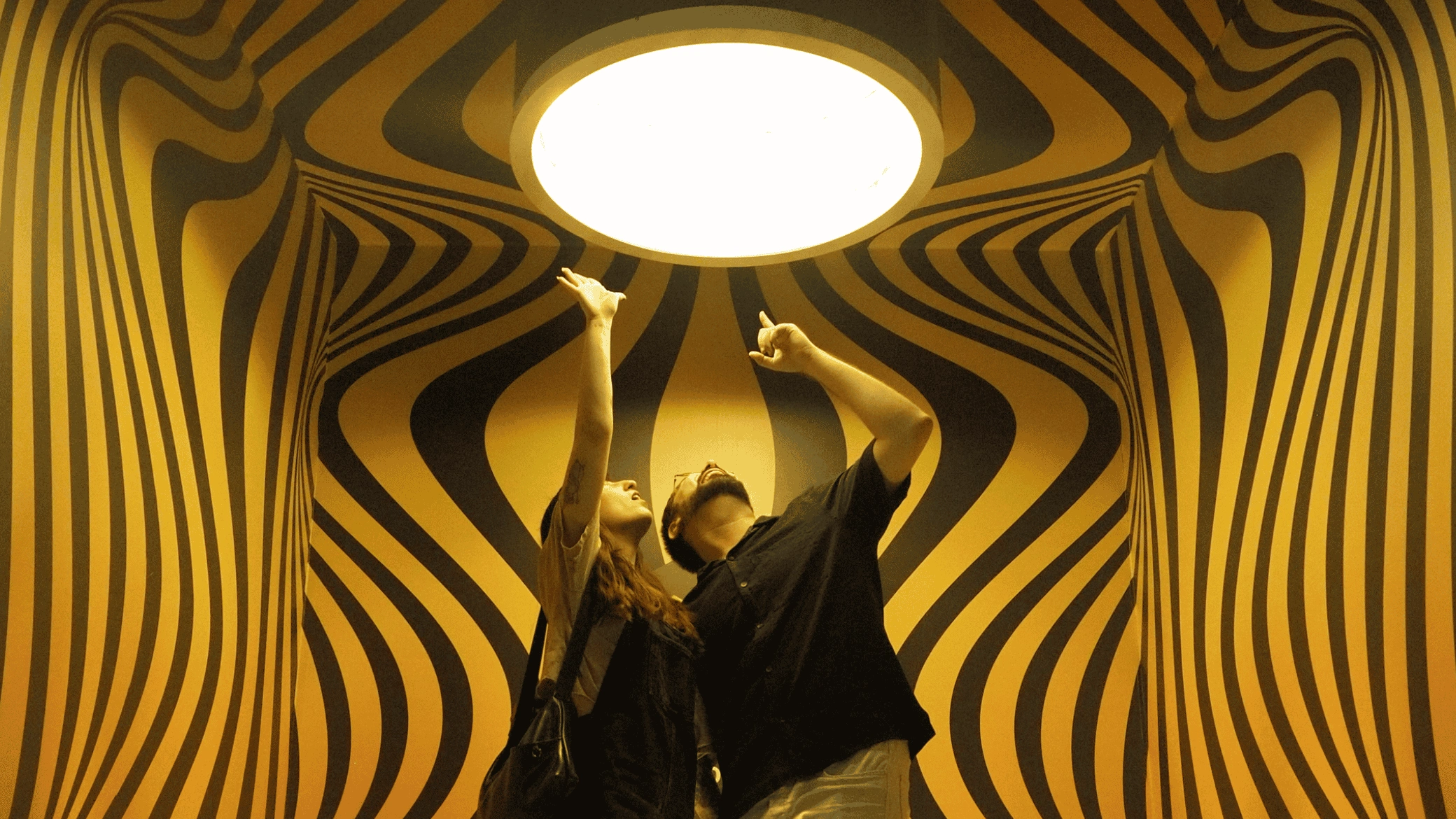
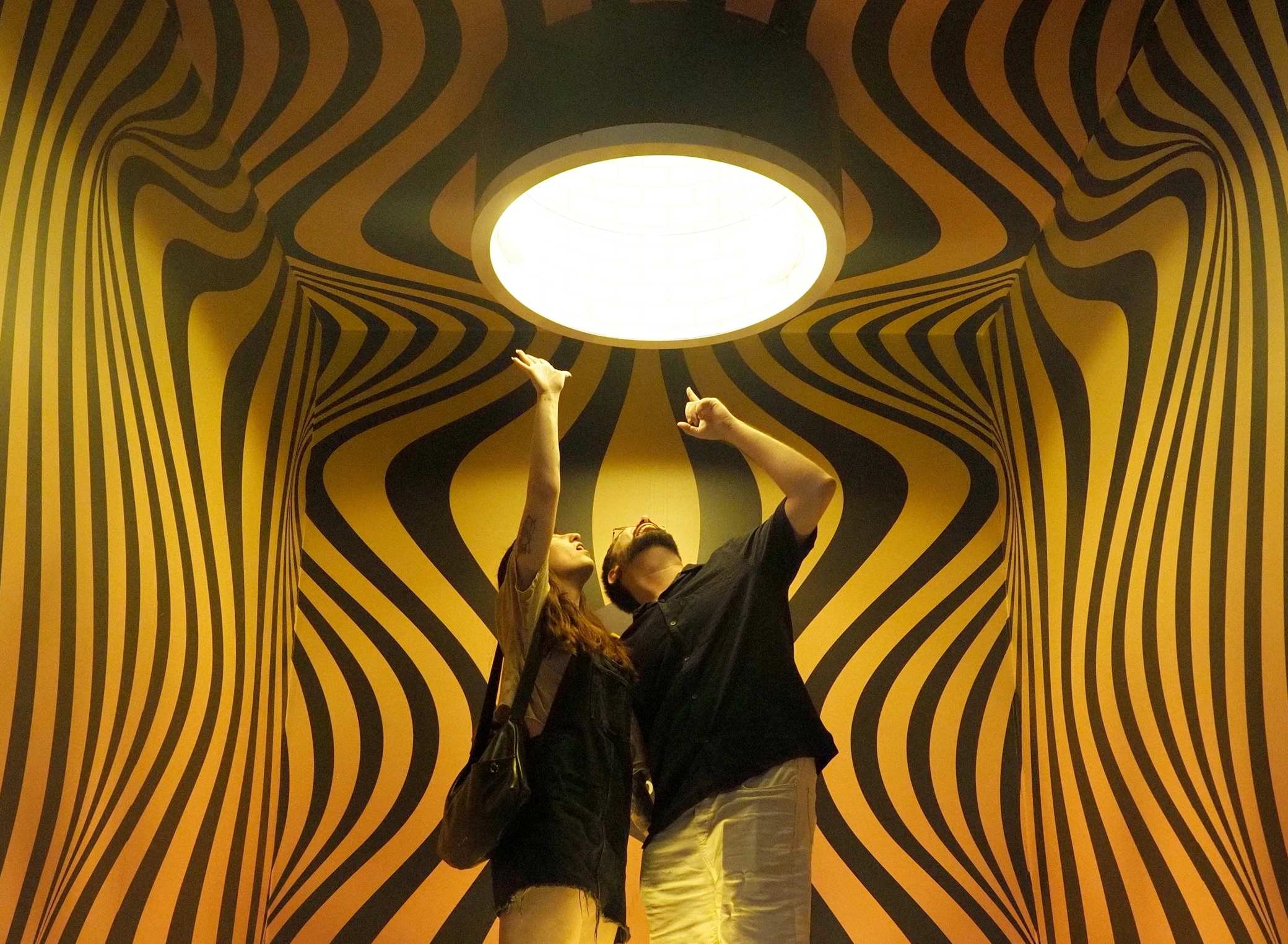
Some optical illusions change what we see. Others do something even stranger: they change our sense of space.
In the Infinity Tunnel and the Infinity Well, a fairly small structure can look far deeper than it really is.
In one, your gaze moves forward as if a corridor were opening up with no end. In the other, the depth seems to continue beneath your feet.
The direction changes, but the optical principle is much the same: a series of reflections makes it feel as if the space continues beyond its real limits.
How does an infinity mirror work?
An infinity mirror usually pairs a standard mirror with a partially reflective surface, set facing each other.
Some of the light passes through the surface and reaches our eyes. The rest bounces between the two mirrors, travelling the same path over and over again.
This creates a series of copies.
Each reflection looks smaller, further away and usually dimmer than the one before. Our visual system reads that sequence as depth, giving the impression of a tunnel stretching into the distance.
But the infinity is only an illusion.
Some light is lost with every reflection, so eventually the images become too faint to make out.
An optical effect that found its way into contemporary art
Facing mirrors have long been used to produce repeated reflections, but in the 20th century the effect also earned a prominent place in art.
In 1965, Yayoi Kusama presented Infinity Mirror Room, Phalli's Field in New York, an installation where mirrors multiplied the shapes inside the room until they seemed practically endless.
The work marked the start of her famous Infinity Mirror Rooms, installations in which reflections, objects and, often, lights create spaces that seem to stretch on forever.
Since then, the technique has also been used in exhibitions, stage design, temporary architecture, shop windows and immersive experiences.
Infinity Tunnel and Infinity Well: the same principle from two directions
The main difference between the two illusions lies less in the optics than in how we perceive depth.
In the Infinity Tunnel, the chain of reflections stretches out in front of you. Your eye follows the lights into the distance, and you feel as if you're looking down a corridor much longer than the actual space.
In the Infinity Well, the same logic shifts downwards.
Here the experience changes because the apparent depth opens up beneath your feet. Even though you know there's a safe surface there, the scene can look like a much deeper drop.
The mechanism is similar.
The orientation makes the sensation completely different.
Unlike the Vortex Tunnel, which plays with your balance, this illusion plays with depth.
Why do the lights make it look even deeper?
The lights act as spatial reference points.
Each point of light reappears in every successive reflection, forming a chain your brain can follow visually.
On top of that, the more distant copies usually look progressively smaller and less intense.
That combination of repetition, apparent shrinking and fading brightness contains the same cues we normally link with objects moving away from us.
That's why the sense of depth can be so convincing, even when we know there's little more than a mirror structure behind it.
From art to spatial design
Infinity mirrors have one clear advantage: they create a sense of great depth within a small space.
That's why the technique turns up in art installations, stage sets, exhibitions, shop windows, events and some interior design projects.
They don't actually make a space bigger.
They make it look deeper.
They're also used decoratively in tables, panels, ceilings and light features, where a limited set of lights seems to continue far beyond the physical surface.
The Infinity Tunnel and Infinity Well in Madrid
At the Museum of Illusions Madrid, the reflection-based spaces are part of a wider experience in which light, mirrors and perspective alter how we perceive our surroundings.
The museum describes its immersive experiences as spaces that challenge your sense of orientation and space, with settings and reflections that seem to extend beyond their limits.
In the Infinity Tunnel, depth seems to move forward.
In the Infinity Well, it seems to fall away.
And in both cases, the illusion proves something very simple: you don't need a huge space to convince your brain there's one right in front of you.