
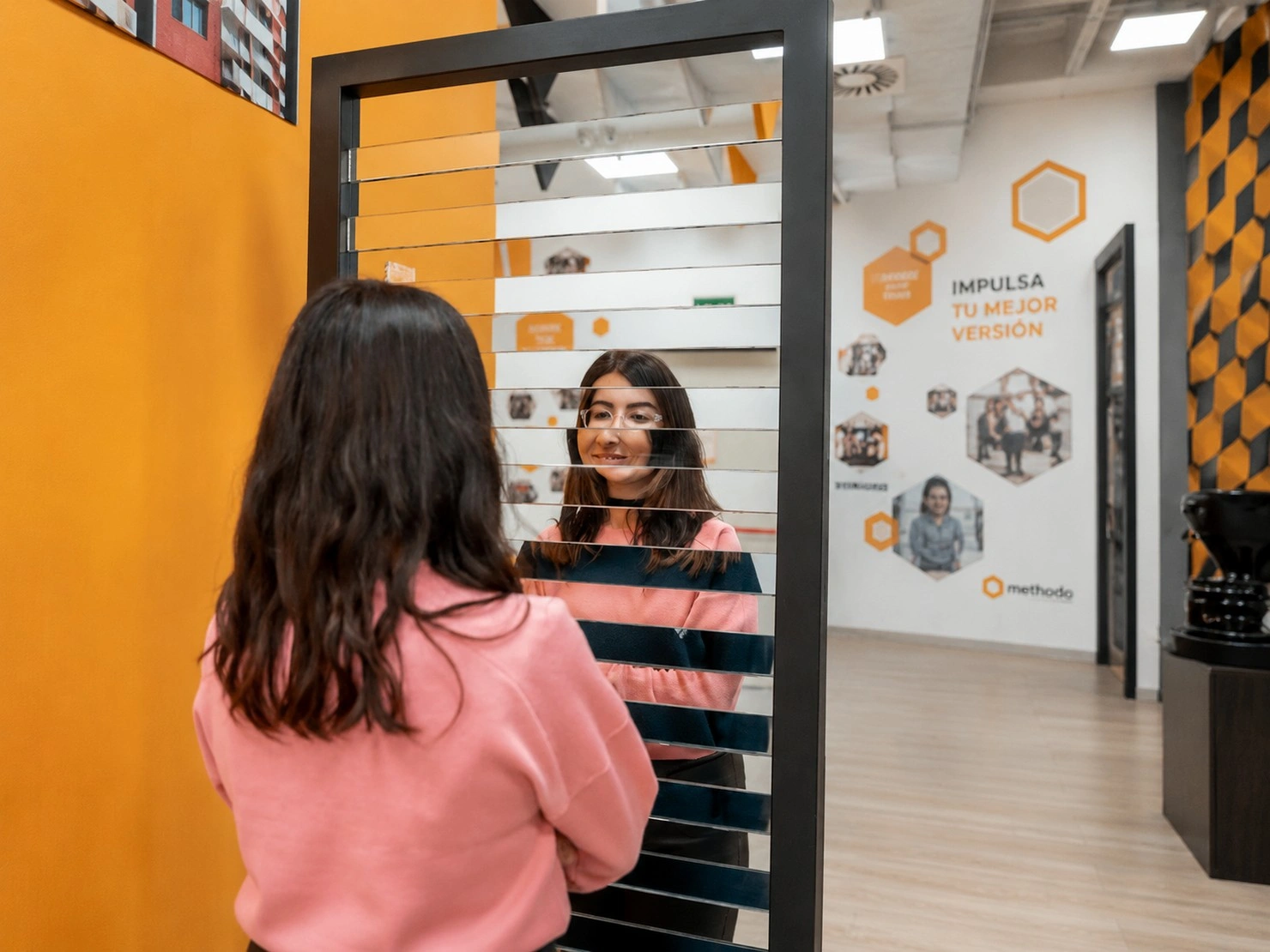
You stand in front of a mirror next to another person… and suddenly it looks like you have exchanged parts of your faces.
Different eyes, an unfamiliar nose, or a face blended between two people creates an image that feels both strange and hilarious.
Even though everything happens in front of a normal mirror, the brain needs a few seconds to understand what it is actually seeing.
Even though everything happens in front of a normal mirror, the brain needs a few seconds to understand what it is actually seeing.
The face swap illusion happens when two people stand in specific positions in front of a mirror and the reflection combines parts of both faces.
The result makes it appear as though facial features such as the eyes, nose, or mouth have been exchanged or blended together.
Although each person remains physically in the same place, the brain interprets the reflection as a single altered face.
It is a simple optical illusion, yet surprisingly effective.
How does this optical illusion work?
The effect is created through mirror positioning and the angle from which the reflection is viewed.
The mirror reflects only certain parts of each face, while the brain automatically combines all the visual information into one coherent image.
The human mind is trained to recognize faces extremely quickly. That is why when facial features appear mixed or misaligned, the brain still tries to reconstruct a complete face even if the image does not truly make sense.
That small “error” in perception is what makes the illusion feel so strange and entertaining.
Why does the brain recognize faces so quickly?
The human brain has a special ability to detect faces even with very little information.
We can recognize expressions, eyes, or smiles in just milliseconds. In fact, the mind constantly searches for faces, even in objects, shadows, or abstract patterns.
This illusion takes advantage of that natural ability.
When the brain receives fragments from two different people, it automatically attempts to merge them into a single face, even when the result seems impossible.
The connection between mirrors and visual perception
Mirrors have been used for centuries to create optical illusions related to symmetry, reflections, and perception.
Depending on the angle and positioning, a mirror can completely alter the way we interpret an image.
That is why many visual illusions use reflections to trick the brain and create impossible effects that appear real at first glance.
The face swap illusion is a perfect example of how something as ordinary as a mirror can completely transform what we think we are seeing.
Face swap illusion at MOI
At the Museum of Illusions Madrid, visitors can experience this fun illusion with friends or family and discover how mirrors can blend faces in completely unexpected ways.
It is one of the museum’s most entertaining experiences because the effect changes depending on who participates and from which angle it is viewed.
The installation transforms a simple reflection into a surprising moment filled with laughter, photos, and visual confusion while revealing how the brain interprets faces and mirrors in ways we rarely notice in everyday life.